The Matte Black Niloticus Crocodile Kelly 28 with Palladium Hardware
In the rarefied universe of high fashion and elite accessory collecting, few items command the immediate awe and reverence of an Hermès exotic leather handbag. Among the vast pantheon of masterpieces produced by the historic Parisian fashion house, the Matte Black Niloticus Crocodile Kelly 28 with Palladium Hardware occupies a legendary space. It is a harmonious convergence of peerless craftsmanship, uncompromising material standards, and understated elegance.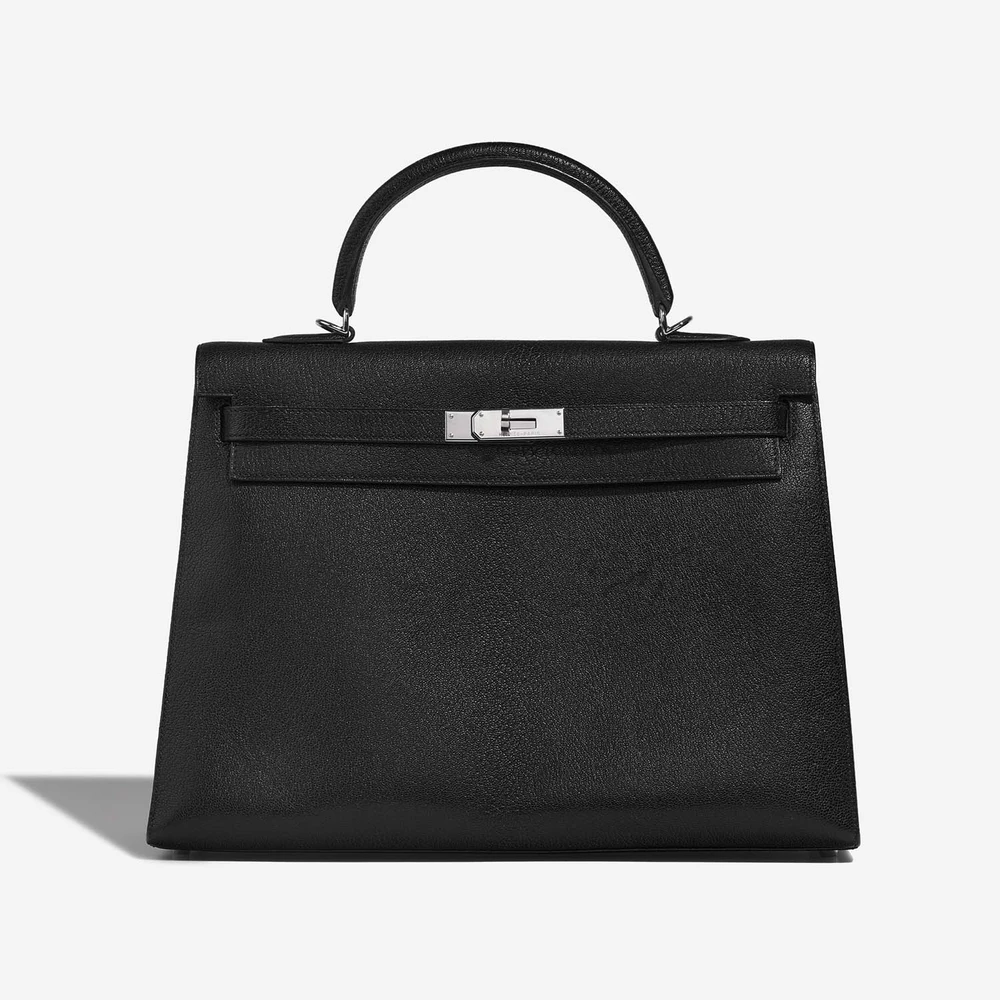
Far more than a mere luxury commodity, this specific configuration represents the zenith of quiet luxury. It bridges the gap between timeless heritage and modern, sophisticated utility, making it one of the most coveted artifacts in the global secondary and primary luxury markets.
Anatomy of an Icon: The Kelly 28 Silhouette
Originally introduced in the 1930s and later renamed in honor of Grace Kelly, the Princess of Monaco, the Kelly bag is defined by its distinct trapezoidal geometry, single top handle, and meticulous saddle-stitching. While the Kelly is available in various dimensions—ranging from the petite Kelly 20 ("Mini Kelly") to the spacious Kelly 35 and 40—the Kelly 28 is widely considered the ultimate "Goldilocks" size.
Measuring roughly 28 centimeters in width, 22 centimeters in height, and 10 centimeters in depth, the Kelly 28 strikes an ideal balance. It is compact enough to transition effortlessly from an afternoon formal luncheon to an evening gala, yet cavernous enough to house daily essentials like a smartphone, cardholder, keys, and cosmetics.
Furthermore, this configuration is frequently sought in the Retourne style—where the bag is sewn inside out and then turned right-side out, resulting in softer, more relaxed lines and rounded, piped edges—or the structured, sharp-edged Sellier variant. In matte black crocodile, the Retourne style offers a supple, touchable grace, while the Sellier projects an architectural, authoritative polish.
The Magnificence of Matte Niloticus Crocodile
The soul of this handbag lies in its exquisite skin. Hermès utilizes several exotic skins, including alligator, ostrich, lizard, and python, but crocodile remains the crown jewel. Within crocodiles, Crocodylus niloticus (native to the River Nile basin in Africa) is prized for its symmetrical, uniform scale pattern, featuring small, distinct square belly scales flanked by rounded sides.
The treatment of the skin is where Hermès elevates taxidermy and tanning into high art:
The Matte Finish: Unlike shiny crocodile, which is buffed with an agate stone to achieve a glass-like sheen, matte crocodile is treated to yield a soft, velvety, and organic texture. It does not shout for attention; instead, it absorbs light quietly, offering a tactile depth that reveals itself only upon close inspection.
The Noir (Black) Hue: True black in a matte exotic skin is deceptively complex. It requires an expert hand to dye the skin deeply and evenly without obscuring the natural grain and scale topography of the crocodile. The result is an inky, bottomless black that feels both modern and eternal.
The Modern Contrast: Palladium Hardware (PHW)
Every Hermès bag is anchored by its metal components—the turn-lock, plate, sangles, feet, and padlock (cadena). While gold hardware (GHW) brings out warmth and traditional opulence, Palladium Hardware (PHW) introduces an icy, contemporary edge.
Palladium is a rare, lustrous silvery-white metal belonging to the platinum group. Highly resistant to tarnish and corrosion, it provides a crisp, cool contrast against the deep, absorbing warmth of the matte black crocodile skin. The interplay between the dark, tactile leather and the bright, mirror-like polish of the palladium creates a sophisticated visual tension that appeals heavily to contemporary collectors who favor minimalist, monochromatic aesthetics.
Craftsmanship and Rarity: The Hermès Standard
To understand the value of a Matte Black Niloticus Crocodile Kelly 28, one must understand the labor involved. Each Hermès bag is constructed entirely by a single artisan from start to finish—a process that can take anywhere from 18 to 25 hours for an exotic skin piece.
The artisan must hand-select and match the scales meticulously across different panels of the bag (the front flap, body, gussets, and handle) to ensure absolute symmetry. Because raw exotic materials are heavily regulated by CITES (Convention on International Trade in Endangered Species) to ensure sustainable and ethical sourcing, the output of Niloticus crocodile bags is strictly limited.
Coupled with Hermès' notoriously stringent boutique allocation system, acquiring this bag directly from an authorized retailer is exceptionally difficult, usually reserved for top-tier VIP clients who have cultivated years of purchase history. Consequently, the secondary market commands immense premiums, with pristine examples frequently trading well above retail price as secure alternative investments.
Conclusion
The Matte Black Niloticus Crocodile Kelly 28 with Palladium Hardware transcends the cyclical nature of seasonal trends. It is an investment-grade masterpiece that marries historical lineage with avant-garde restraint. For the discerning collector, owning this piece is not merely about status; it is an appreciation of the finest materials on earth, shaped by hands that represent the absolutpinnacle of artisanal heritage.


Comments
Post a Comment