The Ultimate Paradox: Deconstructing the Hermès Birkin 25 in Rose Scheherazade & Gris Tourterelle Shiny Niloticus Crocodile
- Get link
- X
- Other Apps
In the stratified world of luxury collectibles, there exists a specific intersection where craftsmanship meets mythology, and where utility surrenders completely to artistry. To discuss the Hermès Birkin 25 in Rose Scheherazade and Gris Tourterelle Shiny Niloticus Crocodile is not merely to discuss a handbag; it is to deconstruct a cultural artifact that sits at the apex of modern material culture. This bag is a masterclass in juxtaposition—where the fiery intensity of a mythical pink meets the stoic calm of a Parisian grey, all rendered on the most lustrous and controversial of exotic skins. It is a piece that forces the observer to question the very nature of value, desire, and the construction of luxury in the 21st century.
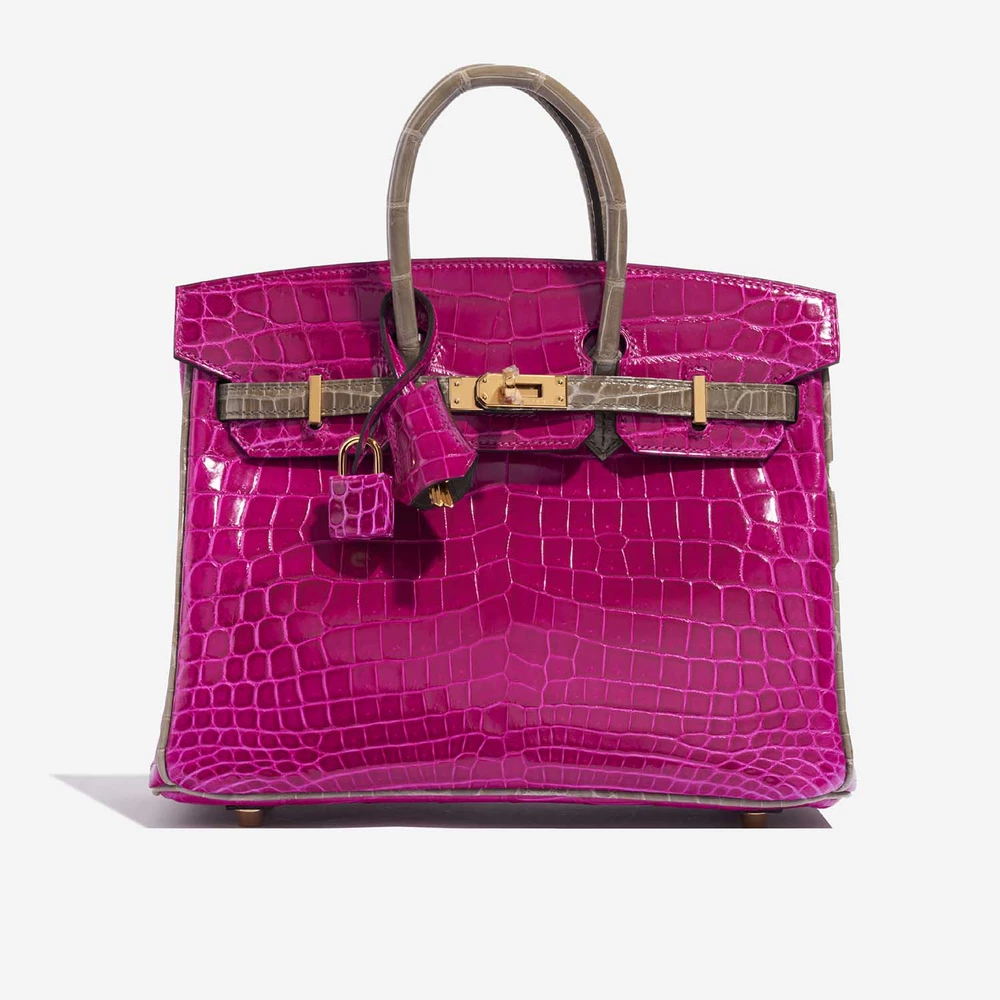
The Canvas: Shiny Niloticus Crocodile
To understand this Birkin, one must first understand its primary material: the Niloticus crocodile. Sourced primarily from the farmed crocodiles of the Nile River basin, this skin is characterized by its large, distinctive scale pattern—specifically the central "back" scales that are larger and more geometric than those of the Porosus or Alligator variants. In the "Shiny" or Lisse finish, the Niloticus skin undergoes a painstaking polishing process that requires immense skill. The scales are buffed and lacquered until they attain a mirror-like finish that does not simply reflect light but seems to capture and hold it.
This glossiness is not without its challenges. Unlike the matte finish, which absorbs light and offers a more understated, masculine texture, the shiny finish amplifies every imperfection. The artisans at Hermès must select skins with absolute uniformity; the scales must be perfectly aligned, and the gradation of the texture must be seamless. The result is a surface that feels almost liquid to the touch—a tactile sensation that defies the reptilian origin of the material. It is slick, cool, and improbably soft for something so structurally rigid. This sheen acts as the perfect foil for the colorways, intensifying their chromatic properties to a near-neon degree.
The Palette: Rose Scheherazade
Color is the emotional language of this bag, and the primary dialect is Rose Scheherazade. Named after the legendary storyteller of One Thousand and One Nights who wove tales to save her own life, this color is a narrative of survival and seduction. It is a vibrant, unapologetic fuchsia that borders on the electric. Yet, it is not a simple pink. It carries deeply embedded cool blue undertones, which prevent it from ever appearing saccharine or juvenile. Instead, Rose Scheherazade is an assertive, confident color—it is the color of a tropical sunset captured at its most volatile moment, or the interior of a rare orchid.
When applied to the Shiny Niloticus, Rose Scheherazade undergoes a chromatic amplification. The gloss of the crocodile acts as a prism, splitting the light and allowing the blue undertones to flicker against the hot pink surface. Depending on the lighting, the bag can appear as a deep berry in low, ambient interiors, or a blinding hot magenta in the midday sun. This duality makes the bag chameleonic; it possesses a chameleonic energy that feels both retro—recalling the flamboyance of the 1980s power-dressing era—and utterly contemporary in its boldness.
The Foil: Gris Tourterelle
If Rose Scheherazade is the protagonist, Gris Tourterelle is its necessary, grounding foil. Translating to "Turtle Dove Grey," this shade is a quiet, nuanced storm. It is a greige—a hybrid of grey and beige—but with a specific, dusty quality that feels melancholic and serene. It is not the mechanical grey of concrete or the sterile grey of steel; it is the grey of a muted dawn, of fog rolling over a European countryside, or the soft down of the bird for which it is named.
The genius of Gris Tourterelle lies in its neutralizing effect. Within the architecture of the Birkin 25—often used for the handles, the sangles (the straps), and the clochette (the lock and key holder)—this color provides a visual anchor. It tempers the explosive energy of the Rose Scheherazade, preventing the bag from becoming a mere pop-art statement. It introduces a sense of High Parisian chic, a nod to the minimalist aesthetic that defines the Hermès house. The contrast is a study in tension: the hot versus the cool, the vivid versus the muted, the mythical versus the mundane.
The Architecture: The Birkin 25
The "25" denotes the size, and in the context of the Hermès hierarchy, this is a crucial variable. The Birkin 25 measures approximately 25cm wide and 19cm high. Compared to its larger cousins—the 30, 35, or the cavernous 40—the 25 is an intimate, almost reticent proposition. It is not a bag designed for utility in the traditional sense. It cannot carry a laptop; it struggles to hold an A4 document. It is a bag designed for the body, not the office.
Its small stature creates a paradoxical effect. Because the bag is smaller, the exotic skin’s details are more concentrated, more magnified. The scale patterns appear denser, and the color saturation feels more intense due to the reduced surface area. It becomes a jewelry piece for the arm, a statement that is inherently personal. The Birkin 25 forces the owner to curate their life; it demands minimalism in what you carry, allowing for a lipstick, a cardholder, and perhaps a phone—nothing more. This constraint elevates the user, suggesting a lifestyle where practicality is a secondary concern to aesthetics.
The Hardware: A Matter of Context
This particular combination is often most striking when paired with Palladium hardware. While Gold hardware is classic and warm, Palladium—with its cool, silver-like sheen—complements the cool undertones of the Rose Scheherazade and the crispness of the Gris Tourterelle. The metallic element acts as a third protagonist, providing a stark, industrial contrast to the organic nature of the crocodile skin. It is the punctuation mark at the end of the sentence, tying the warm exoticism of the leather to the cold precision of the metalwork.
The Artisanal Process
The creation of this bag is a testament to human endurance and skill. A single Birkin takes between 18 to 40 hours to produce by a single artisan. For the Shiny Niloticus, the challenges are multiplied. The hides are brittle compared to calfskin; cutting them requires razor-sharp precision to avoid cracking the edges. The stitching, executed with Hermès’ signature saddle-stitch—a technique inherited from the brand’s equestrian origins—involves two needles and waxed linen thread. This stitch allows the bag to be nearly indestructible; if a thread breaks, the seam will not unravel due to the unique looping method.
The edges of the scales must be meticulously shaved down to ensure the bag closes flat. This process, known as "skiving," reduces the thickness of the hide at the seams, a job that requires an artisan to judge the thickness by feel. The hardware—the locks, keys, and turn-locks—are then fitted to perfection, often containing serial numbers that link back to the specific artisan. This bag is not manufactured; it is authored.
The Investment Narrative
Financially, this bag is less a consumer item and more a blue-chip investment. While the retail price for a Shiny Niloticus Birkin 25 hovers in the high five-figures or low six-figures (depending on the year and market), the resale market tells a different story. At auction houses like Christie’s or Sotheby’s, or via private dealers, this specific color combination commands an astronomical premium. The rarity is twofold: the production of exotic skins is strictly limited due to environmental regulations and the difficulty of the tanning process; and the "Rose Scheherazade" color is often produced in limited seasonal runs.
The collectors’ market is heavily stratified, and the "Himalayan" or "Sapphire" colors often dominate headlines, but the Rose Scheherazade/Gris Tourterelle combo holds a distinct position. It appeals to the "edgy" collector, the individual who wishes to signal wealth but with a punkish disregard for the traditional neutrals. It is the choice of the modern heiress or the entertainment mogul who wants to signal that they are in on the joke—that they are aware of the absurdity of luxury yet choose to partake anyway.
The Social Semiotics
To carry this bag is to participate in a very specific code of social signaling. It is a visual shorthand that communicates several things immediately: the owner is wealthy (obviously), but more importantly, the owner is connected. A Birkin cannot be simply purchased off the shelf; it requires a relationship with the brand, a history of spending, and often, a waitlist that can extend for years. To have the ability to secure a Spec order—where the client chooses the leather, color, and hardware—is the ultimate status flex. It suggests the owner is not merely a customer of Hermès, but a "client."
Furthermore, the use of Shiny Crocodile signals a specific lifestyle. This is not a day-bag for running errands; it is a bag for evenings, for galas, for first-class cabins, and for occasions where the lighting is designed to catch the glint of the scales. It is a heavy bag (crocodile is notoriously weighty), which requires physical strength to carry. This weight acts as a physical anchor, tethering the owner to the object and constantly reminding them of its presence and value.
The Ethical Quandary
One cannot discuss exotic leather without addressing the ethical elephant in the room. The use of crocodile skin is a source of significant controversy, attracting scrutiny from animal rights activists and environmentalists. Hermès, like other luxury houses, defends its practices by highlighting their use of farmed skins that are often subject to strict CITES (Convention on International Trade in Endangered Species) regulations. They argue that the animals are raised in humane conditions and that the use of the skin is a by-product of the meat industry.
However, the aesthetic of Shiny Niloticus is predicated on the perfection of the animal’s life. Scars, bites, or imperfections—which would be natural in the wild—are flaws in the tannery. This pursuit of "perfection" often leads to controversial farming practices. For the conscious collector, this adds a layer of complexity to the ownership experience. The bag becomes a thing to be wrestled with ethically, a symbol of a bygone era where nature was a resource to be conquered and adorned. The sheer brightness of the Rose Scheherazade can sometimes feel like a costume worn over a darker reality.
Conclusion: The Perfect Object
In the final analysis, the Hermès Birkin 25 in Rose Scheherazade and Gris Tourterelle Shiny Niloticus Crocodile is a perfect object—perfect not because it is flawless in a moral or utilitarian sense, but because it achieves exactly what it sets out to do. It is a distillation of desire, a fusion of color theory and material science, and a testament to the human ability to transform the organic into the abstract.
It stands as a monument to a specific kind of wealth—the kind that is loud yet muted, colorful yet grounded. It is a narrative in a box, a story told through the whisper of leather and the gleam of scales. Whether one views it as the pinnacle of artistic achievement or the apotheosis of consumerist excess, one cannot deny its presence. It forces a dialogue about what we value and why. In the hands of its owner, it is more than a bag; it is a shield, a crown, and a secret whispered in a world of shouters. It is, ultimately, the ultimate paradox: an object of immense practicality rendered entirely impractical by its own magnificence.
- Get link
- X
- Other Apps


Comments
Post a Comment